Learning by Failure

I watched the movie Queen of Katwe last week which tells the true story of a girl, Phiona, from Ugandan slums who becomes a world-renowned chess champion. While she wins with ease against other children in her neighborhood, Phiona’s coach tries to convince her to enter a larger scale, more difficult tournament.

Robert Katende (Phiona’s coach): “You must play at Rwabushenyi. It is the premiere tournament in their country. You will be playing international masters… or do you fear losing?”

Phiona: “Losing teaches me how to play better. I will play.” (Nair, Wheeler, & Crothers, 2016)


Teachers, would our students respond like Phiona? Would they play on, fully embracing the likelihood of failure? We know in our hearts that failing can create endless opportunities for learning, but do we convey this on a daily basis in our classrooms?

Three of my classmates and I set out to explore the topic of failure’s place in classrooms more deeply.
Failure

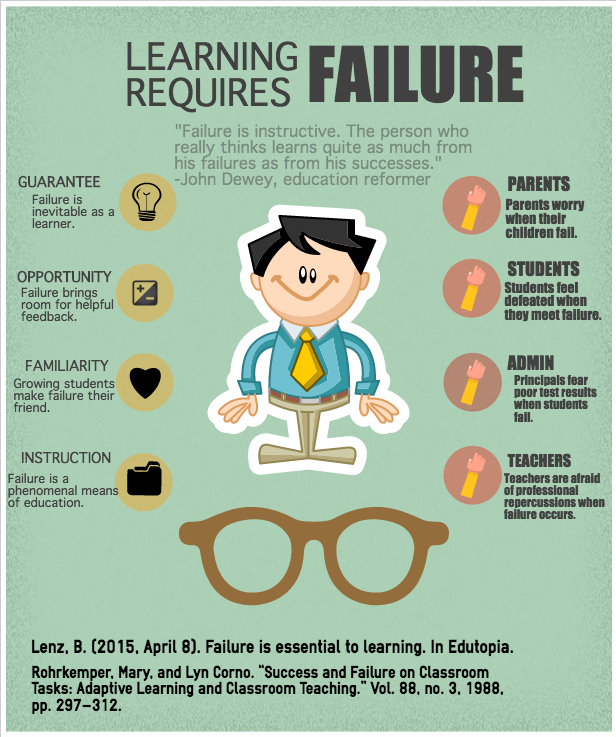
With failure’s benefits in mind (and above on the left 🙂 ), we thought about the concept from a variety of perspectives (see above right). What concerns might arise as failures become more of an honored celebration? What’s stopping teachers and school communities from saying, “Oh, that’s okay; want to learn from your mistakes and try again?”

How can we make failure as powerful a learning tool as success? 

We wanted to allow authentic teaching voices from around the country into the conversation by way of a survey. We received over 100 responses ranging from urban teachers in Colorado to rural area teachers in Mount Pleasant, MI.

Their answers were fascinating in more ways than I can count, but for the purpose of this blog post space, I would like to focus most centrally on one common theme: the presence and support of peers.
Screen Shot 2017-08-17 at 12.50.42 PM

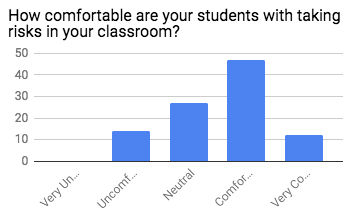
As presented in the above graph, most teachers surveyed that their students were comfortable with taking risks in the classroom. This is reassuring, right? We pat ourselves on the educator back for fostering such a wonderfully risk-taking environment!

Not so fast. The next graph tells a bit of a different story.
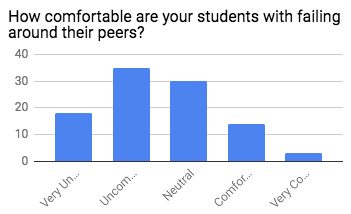
Screen Shot 2017-08-17 at 12.50.28 PM

Even though students are comfortable taking risks, teachers report that students are not comfortable failing around their peers.

Perhaps, then, students are comfortable taking risks on an independent basis but do not want to experience failure around friends and classmates. This certainly limits failure’s potential as a learning tool if students are frightened to allow it in the first place. I began to look into what researchers had to say on the topic.

Developmental psychologist Marilyn Price-Mitchell, PhD. suggests that in order for instances of resilience to occur regularly within a classroom, teachers must “create a classroom culture where failure, setbacks, and disappointment are an expected and honored part of learning” (2015).

How exactly this classroom culture is created depends on classroom context. Kindergarteners will not learn to celebrate failure using the same approach as a tenth grader learning Algebra.

Personally, as a third grade teacher, I plan to spend our first few community sessions discussing some notable people who once met with great difficulty. We may discuss J.K Rowling, for instance, who was out of a work with little funds when she wrote Harry Potter. I will ask questions like, “How do you think Ms. Rowling was feeling at first? What do you think made her keep going?”

I think sometimes kids have the idea that the adults they view as successful had golden opportunities plopped down on their laps. I hope that speaking more honestly about my own failures as well as those of others could be a huge step towards a failure-honoring classroom culture.


My teammates and I collected fascinating information about failure’s classroom role and compiled it into a BlendSpace. Feel free to check it out below if you, too, have a desire to maximize failure’s potential in the classroom.

I’d like to think we’d made Phiona proud.

chart
Check out our BlendSpace on Failure, also found here.


References:

Nair, M. (Director). Wheeler, W., & Crothers, T. (Writer). (2016). Queen of Katwe [Motion picture]. USA: Disney.

Price-Mitchell, M. (2015, May 20). Does your classroom cultivate student resilience?. In Edutopia.


Deeply Enjoying the Classroom View

I grew up in the same home as a dedicated teacher, and still, when I started teaching, I was blown away by its difficulty. People who do not teach cannot even begin to understand the job’s complexity: the rushed lunches, the wide range of student needs, the Sunday night lesson planning sessions, the 12 hour days during parent-teacher conferences, the weight of having 25 minds dependent on you for measurable growth.

I am sure that every job has challenges. Teaching has a lot of them, especially if you strive for perfection.

It is an important but difficult work. 

As I begin the school year quickly approaching, I am keeping a quote from David McCullough’s graduation speech (as qtd. in Berger, 2014, p. 181) in mind:

“Climb the mountain not to plant your flag, but to embrace the challenge, enjoy the air, and behold the view.”

Dear friends, the “views” from where I stand atop my teaching mountain are so often such great ones.

In about ten seconds of considering the beauty of my career, I can come up with these instances:

  • There is a reading tent in the corner of my room. Each day, I glimpse a kiddo snuggled up inside, focused intently on a really good book.
  • I take my class to the Michigan State Capitol building. There is nothing like the sight of eight-year-olds lying on the floor to gaze upon the stunning rotunda. They are wowed.
  • We make applesauce in the fall while we learn about Michigan fruit farmers. Our classroom smells of warm, cinnamon goodness.
  • I work with a teaching partner who is also beginning his career. He is laid-back about most things, makes my copies, and watches my class every single time I need to run to the bathroom.
  • I get to go to work and share my love of children’s literature with delighted children. Is there a better gift on Earth? 

I strive to improve my instructional practices daily. I do “embrace the challenges” that come with climbing this “mountain” of a profession.

But this year, I’m also striving to not let my quest to become a perfect 3rd grade teacher interfere with giving thanks for the lovely views that grace each and every day.

What classroom “views” are you grateful for? It always helps to write them down. 

Reference:

Berger, W. (2016). A More Beautiful Question: The Power of Inquiry to Spark Breakthrough Ideas. New York: Bloomsbury.

All photos belong to author.

Connections and Curiosity

I traveled to Germany, Austria, and France to visit European friends about a year ago. It was my first time overseas, and despite feeling nonstop anxiety for weeks leading up to my trip, I came home yearning for a return trip across the Pond. Furthermore, though, I came home curious.

I began checking BBC for news in the morning to get a feel for European happenings rather than only American journalism. I visited German restaurants in Detroit and Grand Rapids, hoping to try new kinds of spaetzle or introduce my family to Spezi (Coca-Cola mixed with orange pop; it’s surprisingly tasty).

Heidelberg
My German friend, Lisa, and I take in Heidelberg’s stunning sights.

I think my newfound curiosity was due to both the fact that I had seen and experienced these places as well as hugged people who lived in them.

When I hear about Munich on the news now, I consider how the circumstances could affect my friend Sanja’s work or the experiences of tourists. Headlines about European Union border control make me wonder about how people who live in one country but work in another handle long wait times on their commutes.

Prior to my travels, I didn’t have a lot of buy-in when presented with the opportunity to learn something about European living, but now? My curiosity is always peaked.

I want that kind of curiosity in my classroom, so I must forge the connections. 

Each day in Room 21, I use my passions and even my people to awaken my students’ minds to this big and beautiful world.

We’ve Skyped an archeaologist, taken Google Earth field trips of Mackinac Island, and celebrated the holidays with yule logs as they do in France (Joyeaux Noel!).

It is so wrong to assume that my students will arrive to school yearning to know more about Mackinac Island or French voyageurs. But friends, by the time they leave at 3:00, I hope they are yearning indeed.

All photos belong to author. 

How Can I Make My Room a Home?

I have been reading A More Beautiful Question by Warren Berger for my educational technology classes this summer. It emphasizes the importance of remaining curious and asking questions, especially to challenge the status quo. I love this approach especially when facing circumstances that might be unfavorable.

Berger writes, “Confronted with a challenge or problem, one could respond with the question Oh my God, what are we going to do? Faced with the same situation, one might ask, What if this change represents an opportunity for us?” (Berger, 2014, p. 19).

Despite my newfound fondness for questions, I know there is one question that I will never know the exact answer to: How were the evenings and mornings for my students?

There is simply no way to know every detail of my students’ lives. They spend such a large portion of their waking hours with me, but outside of our time together, I cannot be certain of the challenges they face or joys they encounter.

Did my students eat a healthy breakfast this morning? Did they wake themselves up or have someone singing them a good morning song? If my students had trouble with the math homework, could someone help them through it? Is there conflict in my students’ homes right now? Who is sharing their apartment or bedroom? 

I make my absolute best effort to be familiar with my students’ lives outside of school, but I must not pretend to have all of the details.

Rather than dwelling on the answers I will never have, I have chosen to ask questions that could urge me towards creating a more stable classroom “home” for all children, regardless of how their evenings went.

WHY // I must identify my initial wonderings about the students in my classroom.

  • Why is it harder for some students than others to get started with schoolwork in the morning?
  • Why do my students have trouble treating each other like members of the same community?

WHAT IF // I must identify possible changes that may address my questions. 

  • What if everyday began with a Community Meeting?
  • What if team-building and mindfulness had a bigger place in our day?
  • What if my room was designed as a place of peace?
  • What if my teaching partner and I sought to continually model a positive friendship?

HOW // I must identify ways to implement these changes.

  • How can I create a gathering space for Community Meetings?
  • How can I design my classroom to feel peaceful and calm?
  • How can I put routines in place to allow for thinking time and class games?
  • How can I design my room to allow for collaborative work practice time?
  • How can my teaching partner and I demonstrate mutual respect for each other on a daily basis?
Reading corner
My favorite peaceful spot: the reading corner.

By thinking through this Why/What If/How process, I am not focusing my negative attention on the answers I wish I had. Instead, the process urges me to devote my energy towards finding solutions.

Teaching Partner
Our students have a front row seat to the friendship my teaching partner and I share. It is important that we demonstrate kindness!

I will probably not create a perfectly peaceful environment overnight. But asking myself questions about my classroom and teaching practices can only better the time I share with these 25 little people inside our school day “home.”

Reference:

Berger, W. (2016). A More Beautiful Question: The Power of Inquiry to Spark Breakthrough Ideas. New York: Bloomsbury.

All photos belong to author.

Aloha from the World’s Newest Ukelele Player!

Because I was challenged to learn the ukulele using only online resources, so many of my summer evening views looked like this:

Screen Shot 2017-08-12 at 12.27.55 PM.png

Perhaps my social media followers grew tired of my ukulele-inspired updates, but I so enjoyed hearing from friends and relatives along the way, some of whom had once played the ukulele themselves.

Having an instant support system made me eager to share even the smallest accomplishment, such as learning to play, “Row, Row, Row Your Boat:”

Screen Shot 2017-08-12 at 1.03.42 PM

I may have been learning on my own without anyone sitting next to me on the porch bench, but my journey was surely more enjoyable as I laughed and celebrated with peers. My Master’s class is reading A More Beautiful Question by Warren Berger (it’s wonderful!), and the book includes one finding that especially applies to my journey.

Researchers set out to discover what brought people happiness. The answer?

Connection with others. 

“The happiest people he encountered– including some living extremely modestly– had a strong connection to those around them” (Berger, 2016, p. 192).

In all of the hills and valleys of this ukulele-learning-venture, it was sharing them with loved ones that brought me the most sincere joy.


It is one of my greatest teacher hopes that when my third graders walk through the classroom door, they feel a sense of peaceful connectedness to one another and to our school community.

I wanted to learn to play the ukulele to enhance my class’ Morning Meeting time. I thought singing to a fun ukulele song might help students start their day off happily and encourage a closely-knit classroom community. My school year doesn’t start for a few weeks, so the verdict is still out on my third grade success rate; however, I’ve been strumming away on this four-stringed instrument for a month now, and every single time, I’m smiling.


If you are interested in bringing the ukulele to your classroom, here is a video with two uplifting Morning Meeting-style songs and even some instructional tips at the end. Consider yourself warned that while I do have basic ukulele skills, my singing skills are still far inferior. 🙂

With those tips in mind, I so encourage you to check out Cynthia Lin Music on YouTube. Her instructional speed is perfect for beginners with lots of repetition.

May your day be filled with peace and good vibes from this newly-minted uke player to (maybe) another,

Brynlee


Reference:

Berger, W. A More Beautiful Question. New York, NY: Bloomsbury.

A 21st Century Classroom for 21st Century Learners

The Need to Chat and Wiggle

I am a 24-year-old educator, and as I was sitting in a classroom chair typing this blog post, I felt the need to wiggle. I came up with excuses to get up and move. For example, I decided my water bottle needed filling, I should really walk to the bathroom, and maybe I can say hi to the teacher next-door?

Who am I reminding myself of?

My third graders try each of these excuses at least once during the school day. My usual response has been, “No, you just went to the bathroom. Sit down.” But now, after being a student again, I empathize with them! It is hard to sit still for long periods of time.

Third graders need to move and chat. Truly, if I desire a classroom full of collaborative, creative thinkers, I need them to move and chat!

I am beginning to understand that the rows of desks inside my classroom do not “support a child’s natural instinct to learn through creation and discovery” (Le, as cited in O’Donnell et.al., 2010). My current desk set-up supports 18th and 19th century public schooling needs: conformity and teacher-student hierarchy (O’Donnell et.al., 2010). I stand in the front teaching, and they sit quietly to learn.

This is not an applicable approach to problem-solving and creativity, nor does it teach students much about life in current society. I can’t imagine the workplace without bouncing ideas off my classroom neighbor or waving in the hallway to other teaching friends.

Ideating Dream Improvements

If I were to redesign my classroom without any budget constraints, I would be sure to allow for greater movement within my classroom. Each table and chair would be on casters and easily movable for group activities. This would make forming groups much, much easier without dragging heavy desks across the carpet.

Classroom design
Each chair and table rests on casters, allowing for simple movement.

Furthermore, each chair has a space beneath it for students’ belongings. Keeping a desk clean is a hard skill for third graders, and there is much more flexibility in room design when 25 desks aren’t included!

In The Third Teacher’s “79 Ways You Can Use Design to Transform Teaching + Learning,” there is mention of encouraging students to be “eco-educated.” Recycling is a lifelong skill and step towards a sustainable lifestyle, so I would start the habits early with inclusion of a recycling bin in my classroom, as seen in the right corner below the map. Screen Shot 2017-08-11 at 2.56.07 PM

I included a large, bulletin board map because we love to connect with classrooms across the nation in Room 21 and collect postcards from each state. The size of the map would allow for my students to look closely at the location of each state and even stick pushpins in the states we’ve received.

Speaking of pushpins, if I could, I would make each wall in my classroom have a tackable surface. My current classroom is made of cement blocks, and I dream of hanging student work and anchor charts easily on each wall with thumbtacks.

For a classroom’s design to truly be human-centered, its designer ought to take into account the height of the students. The bulletin boards & projection screen I have currently are higher up on the walls which can make them hard to reach for several of my students. If my entire walls were tackable, I could hang charts and posters closer to their eye-level.

I took height into consideration when designing a whiteboard. The whiteboard in my prototype reaches to the floor so that students of all heights may access it and use it themselves without requiring a chair.

Screen Shot 2017-08-11 at 3.04.04 PM

Because I value collaboration and teamwork, I wanted to create a space where that could occur. Therefore, I designed a spot behind my bookshelf with two floor cushions. This is a secluded spot and will be perfect for partner work, allowing students to sit (or wiggle!) in a way that is most comfortable to them.

Birdseye
See floor cushions behind library bookshelf in bottom left.

I do teach whole group often in third grade, especially during read-alouds. Therefore, I included a gathering area with floor rug. A teacher center with document camera and laptop computer can be seen near the rug for easy access.

Could I try it “for real?”

While I wish I had tables and chairs that rolled easily, I do not at this moment. However, even with 25 desks in my room, there are still ideas I might test this year. I would like to create a “collaboration cove” where students could sit on floor cushions and work together.

I would also like to get rid of my big, bulky teacher desk in favor of a stand with a projector and ELMO on it. I rarely sit at my desk during the day, and it would open up much more room for students to roam.

If these changes allow my students to work together more frequently and seamlessly, I know they will have been a Room 21 success.


Reference:

O’Donnell, Wicklund, Pigozzi, and Peterson, Architects Inc., VS Furniture., & Bruce Mau Design. (2010). The third teacher: 79 ways you can use design to transform teaching & learning. New York: Abrams.


Success Stories: A Factual Account of a Creative and Innovative School Makerspace

As a first-year teacher last fall, I was truly just grateful for the gift of my very own classroom. The hanging pencil sign outside my door with “Miss Pomper” painted on it could have pointed to a tiny room in Antarctica, and I would have been happily searching for really warm decor ideas.

However, my school provided me with even more than a beautiful classroom of my own. I received the gift of a makerspace room right down the hall.

If you are thinking of a spot filled with fancy, pricey tech toys and wires, you are partially correct. I am fortunate that the school in which I teach places great value on coding skills and technological ventures.

But friends, our makerspace is more than that.

It is called “The IDEA Lab,” an acronym for Invention, Design, Engineering, Art, and has Legos galore, boxes of toilet paper rolls, plenty of cardboard, bunches of plastic grass found in Easter baskets, and the usual crayons/markers/glue/glitter.

There is worry within the maker community that including makerspaces in schools could “quash the emergence, creativity, innovation, and entrepreneurial spirit that are hallmarks of the ‘maker revolution'” (Halverson & Sheridan, 2014, p.500).

I would like to provide reassurance that creative and innovative spirits are alive and well at Star Elementary School.

  • Pairs of third grade peers are huddled around Idea Lab tables, armed with paperclips in each hand. They are completing a teambuilding exercise in which they must move a gummy worm through a Lifesaver using only the paperclips. I hear laughter and the words, “Let’s try again!” over and over. This is innovation.
makerspace
New friends work together to save “Fred” the gummy worm from drowning
  • There is plastic Easter grass all over the floor. Students are working to create an item that celebrates America’s National Parks 100th anniversary. Toilet paper tubes become palm trees, green foam becomes turtles, rivers of glitter sparkle. This is creativity.

I know that the American elementary school is not always as free-thinking and exploratory as it could be. But a word to the maker community: teachers are on your side. 

We know it is “our job to set up situations whereby all learners have the opportunity to engage” (Halverson & Sheridan, 2014, p.500). While this is my mission in my own classroom as well, it is such a treat to have a designated place for this kind of engagement.

My students know that a trip to the Idea Lab will require teamwork and bring smiles. They know that it will likely push them out of their comfort zones, that they will probably build and play and even fail.

What happens as they build, play, smile, and fail? My students are becoming more comfortable with out-of-the-box thinking, problem-solving, working together, and even the idea of trying again. 

My school has a makerspace, and it is a wonder.

IMG_6948
Teachers create, play, and work together in the Idea Lab as we learn to create this experience for our students. Photo belongs to Keith Tramper and used with permission.


Reference:

Halverson, E.R. & Sheridan, K. (2014). The maker movement in educationHarvard Educational Review, 84(4), 495-465.

Creating a Digital Scrapbook Page with Google Drawings

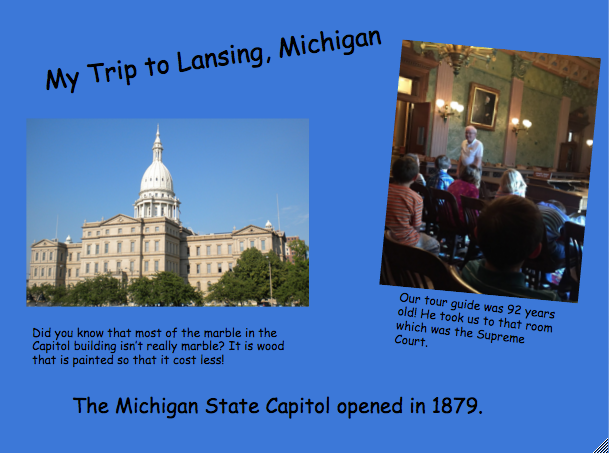
Each spring, I take my third graders to tour the Michigan State Capitol to complete our social studies unit on Michigan’s government. I teach in a small, rural town, so a glimpse of the Lansing skyline alone is a sight to behold for many of my students; the knowledgeable tour guide and breath-taking Senate chambers serve merely as icing on the cake. The day is full and overwhelming, without much opportunity for the students to think about all they have learned and seen.

Therefore, during our next day back at school, I provide time for discussion and reflection. A “turn and talk” time during Morning Meeting is a great start, but I want students to be able to create and produce a finished product that epitomizes their field trip.

Enter: a Google Drawings “scrapbook page” about our day in Lansing.

Exemplar
An example of an in-progress field trip Drawings page

The lesson plan in its entirety can be found at the bottom of the page, but first, let me convince you to give Drawings a try for your next classroom field trip. It is truly the perfect mix of good pedagogy, quality content exploration, and meaningful technology usage, meeting the TPACK framework well.

First, as quality educators, we know that no learning experience is maximized to its fullest potential if we move on instantly at its conclusion. Many of my students have never been inside an old, ornate building before. Do I want to take them, let them check it out, and move on to geography the very next school day?

Absolutely not. Allowing time to reflect on new knowledge and experiences is simply knowledgeable pedagogy.

Secondly, the experience has social studies and writing content woven throughout. I require my students to include Capitol facts in their drawing, and it is great for them to practice writing in an unfamiliar genre.

Students must consider what key parts of the trip they most want to share. They know that including 17 facts they learned on one Google Drawing will not make for a very visually appealing creation, so the assignment requires them to prioritize information.

Lastly, Google Drawings is an authentic technological tool that most third graders have not used before. While some are intimidated by the “adultness” of the program, they gain confidence quickly as they play with fonts, crop pictures, and of course, turn their title headings 45 different colors. 🙂

Because I utilize Google Classroom, the students can also turn their Google Drawings work in easily without any emailing required.

I also provide a selection of class pictures in a folder shared on Google Classroom, so students are also practicing downloading and uploading pictures in addition to using the Google Images search bar. This is a skill they will likely need for years to come, and I am happy to provide an experience to become more familiar.

I hope my lesson plan provides a helpful starting point if you are considering a post-field trip scrapbook page in your own classroom. Field trips rock, and so can the day after.

Reference:

Mishra, P., & Koehler, M. J. (2006). Technological pedagogical content knowledge: A framework for teacher knowledge. Teachers College Record, 108(6), 1017-1054. DOI: 10.1111/j.1467-9620.2006.00684.x

All photos belong to author. 

I tuned a ukulele without my dad’s help.

I teach in a small town without thousands of apartment options yet I do have thousands in student loans, so the answer to both conundrums is life in my childhood home with my two really gracious parents.

One of these really gracious parents, my dad, is just plain musical. He plays the piano for our church, fixes accordions in his spare time, and has a guitar he tinkers with (quite well, I might add) on occasion. One of our neighbors has been attempting to learn the guitar for a few years and visits once in awhile to show my family his progress. My dad, who does not devote nearly as much time to the guitar as our persevering neighbor, can play right along with him, prompting our neighbor to frustratingly tell his wife, “He doesn’t even need to practice! It just comes right to him.”

Friends, I am a growth mindset junkie, but the man has a gift.

Ever since the unboxing of my ukulele last week, I have grown new empathy for my neighbor. My dad seems to think that this new instrument is ours, and he can pick it right up (in more than one sense).

Dad and the Ukulele
Excuse the dog toys! My brother and puppy, Crew, look on as my dad masters the freshly-opened Pomper instrument

Because I am to be dependent on online resources, I have refused my dad’s know-how again. And again.

Other than correctly placing the battery in the tuner for me, my dad has watched his firstborn struggle with tasks he could easily complete. While I almost started to wish he could just show me, I reminded myself of the goodness found in productive struggle. Learning a ukulele on my own was not going to be an easy task, and I wanted to develop the perseverance that I would surely need throughout the process.

Did you know that students who have had the opportunity to fail and problem solve tend to “transfer the knowledge they’ve gathered more effectively than those who were the passive recipients of someone else’s expertise” (Paul, 2012, para. 4)? It is good for me to struggle. 

As the student, I feel a little frustrated but also empowered. I am excited by each new chord I learn, having done so without someone positioning my fingers.

But most days I am the teacher, so I can relate to how hard it must be for my dad to watch me be challenged without flying in like Superman with his musically-gifted-cape.

Okay, but what exactly did I learn? 

A week ago at this time, I knew nothing about the ukulele other than its name.

Today, I can tune one. 

It was a rocky process. Using the electric tuner provided and a Ukulele Teacher video, I tuned all four strings until the tuner light glowed green. However, after noticing that my strums didn’t sound like the teacher’s, I realized that I had been holding the ukulele in opposite hands than the instructor and thus had tuned the entire thing upside down.  I thought my dad was going to cry.

I then searched for a YouTube video that taught the absolute basics: from how to hold the instrument correctly to strumming instruction. I found the approach I needed in Cynthia Lin Music.

She has a series of 6 beginner videos that build on each other, teaching various chords and techniques along the way. It’s gold.

The OokTown podcast has been fun to listen to– who knew there was such a passionate crowd of ukulele fans in the world?– but I have not yet explored the website’s video lesson component.

Future Strums: I have decided to learn to play “Three Little Birds” and “Don’t Worry, Be Happy.” I think the positive message in each will bring a happy spark to my classroom Morning Meetings.

Stay tuned– pun intended.

Reference:

Paul, A. M. (2012, April 25). Why floundering is good [Electronic version]. Time.

All images belong to author unless otherwise noted. 

MakerFaire Magic

Wait, what’s a MakerFaire? 

Prior to beginning an Educational Technology program at Michigan State, let me share my experience with MakerFaires: I walked by a Mini MakerFaire once near the beach in St. Joseph. That’s it.

I remember seeing plenty of cardboard, but truthfully, I had Lake Michigan on my mind and didn’t take the time to spectate.

Perhaps that is the reason for my instant anxiety upon hearing that my classmates and I were responsible for planning and executing a MakerFaire with a mere nine days of work time. I had not yet truly experienced a MakerFaire as an attendee, and now I was part of the planning committee? How could that be?

In a quest for greater “maker” knowledge, I watched a TED Talk by Jeff Sturges. He states, “I really think we’re all makers. We have these things called hands with opposable thumbs.”

This quote brought peace to my frazzled brain. If EVERYONE is a maker, then I could certainly figure this out! The possibilities were endless.

I learned that MakerFaires are events, varied in scale, that exist to encourage hands-on creativity. For example, visitors to the enormous Detroit MakerFaire might try a wearable video game system while guests at the Southwest Michigan MiniMakerFaire can learn how to solder. Pretty much anything goes!


We planned a #MAETCircuitCircus

My partner, Alex, and I were responsible for planning a hands-on exhibit which could engage visitors of all ages. We had both enjoyed the circuit-centered activities we had tried in class, specifically the Squishy Circuits. I had wanted our activity to include common household items, so the Squishy Circuit kits seemed to be a perfect compromise: an unfamiliar technology with a very common childhood medium.

Squishy Circuits
Testing out the Squishy Circuit kits in class; I have a newfound appreciation for Play-Doh! // Photo taken by author

While we knew of the technology we wanted to utilize, we had great difficulty deciding on what exactly our visitors could do as they played to learn.

We decided to come up with a list of scaffolded challenges that would demonstrate various aspects of the electric circuit. For example, the challenge “Make a light bulb go out without removing the power source or the light bulb” led visitors to notice the short that occurs when touching the two pieces of Play-Doh together.

For a complete list of the challenges we posed, please see our Circuit Circus Challenges. 


How did it go? 

Thursday, July 20th quickly arrived, as did visitors to our MakerFaire! It was a joy to watch third and fourth grade kiddos from a Spartan Writing Camp take on the circuits, working seamlessly together throughout each iteration.

It was obvious that the Writing Camp instructors had discussed working together as a team. While I reviewed the use of accountable talk before they began, I was not expecting how well the campers would take turns and actively listen to one another.

Screen Shot 2017-07-21 at 12.11.59 AM
Teamwork makes the dream work, my friends. // Photo taken by author

This portion of our MakerFaire morning served as a great reminder for my own classroom. I can talk my students’ ears off all day about speaking nicely to each other and working as a team, but in the end? I need to stop talking and give them the freedom to try. 

This is part of teaching with which I am challenged. I want to guide my students each part of the way, and it is difficult for me to watch them struggle without jumping in.

However, the MakerFaire reinforced what my summer courses have shouted from the rooftops: kids can. They are capable of collaborating, of facing difficulties, of building, of creating, of figuring it out. Sometimes, I just need to get out of the way.


Try it yourself!

Are you interested in replicating a MakerFaire experience in your own classroom? If you are particularly fascinated by Squishy Circuit challenges, here is a Circuit Challenge Guide used for my own planning purposes.

If your interest lies in more general MakerFaire plans, here are a few tricks that may be of use:

  • It is easy to be caught up in the exhibit plans and forget about logistics. For example, ensure that signage within the event building is plentiful! Enjoyment surely suffers when people aren’t sure where to head.
  • Utilize social media all that you can. Create a hashtag for your event; this helps visitors feel connected from the start.
  • Prizes aren’t necessary, but people of all ages love to be recognized! Project a leader board or create a congratulatory board for those who have completed your challenge. Pictured below is the Wall of Fame we used; visitors could write their name on the whiteboard if they mastered the challenges.
Screen Shot 2017-07-21 at 1.16.16 PM
This wall was signed by engineers of all ages. // Photo belongs to author

For more information on the Maker Movement, I highly recommend the aforementioned TED Talk by Jeff Sturges.

References:

Sturges, J. (2014, Jan.) The maker movement. Retrieved from http://www.youtube.com/watch?v=-uIXJclJE2Y.